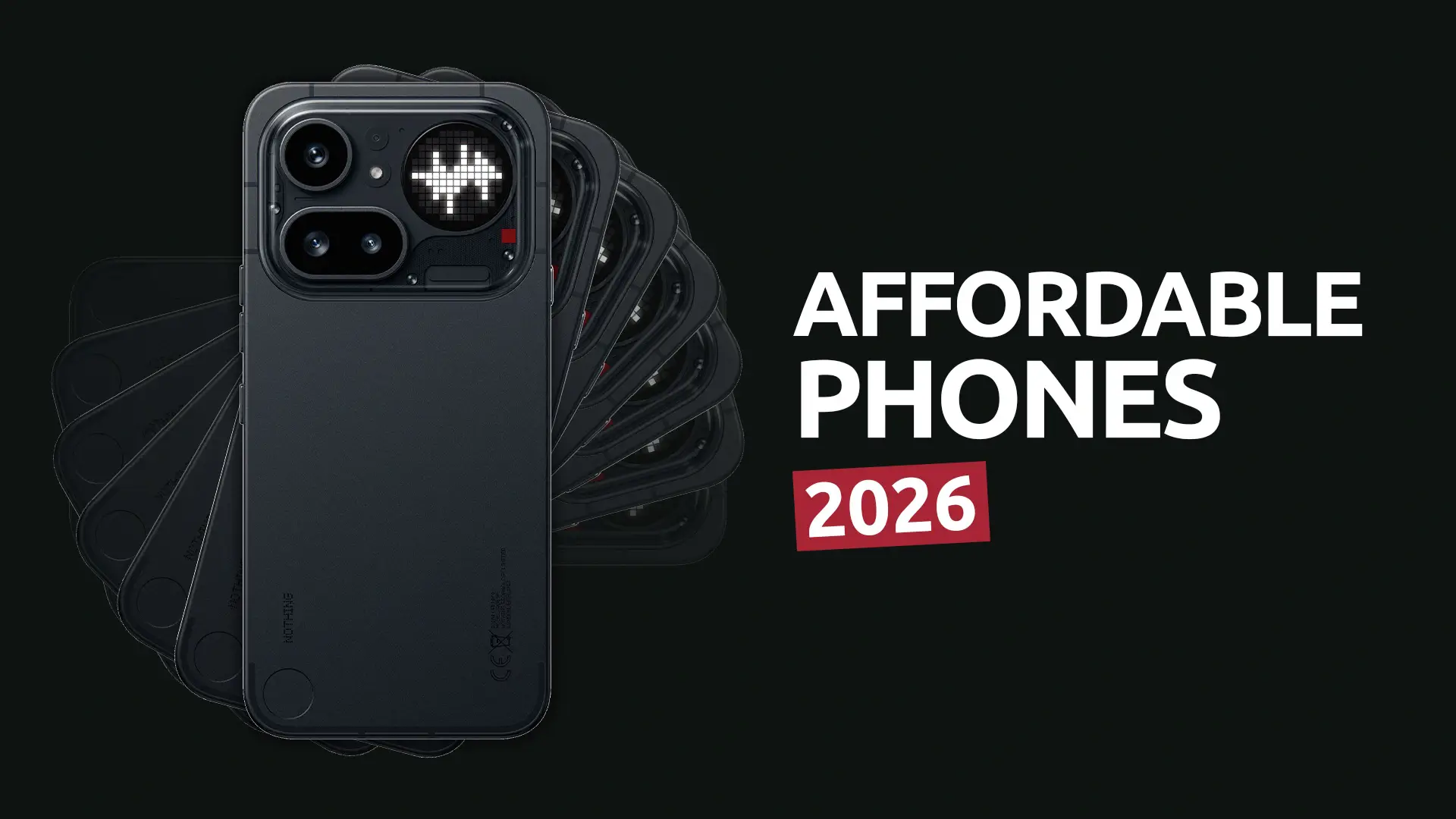

Flagship phones keep getting more expensive, but did you know there are plenty of phones that can do the work for you at a better price?
Instead of getting a phone for $1,000+, you can cut the costs by half and still get a good deal for a phone with good specs. And while everybody’s needs are different, we will explore some of the best affordable smartphones released in 2026 with different features – some have great camera and AI features, others are good for gaming, or come with superior battery life. Wonder what your best options are? Let’s check out these 8 affordable phones released in 2026.
Mid-Range phone with a metal body:
1. Nothing Phone 4a Pro ($499)

The new Nothing Phone 4a Pro was announced back in March, and it easily became one of the most distinctive mid-range smartphones of 2026. While most phones in this price range rely heavily on plastic, Nothing pushes a more premium direction, introducing an aluminum unibody design paired with the unique Glyph Matrix lighting interface.
It not only looks amazing, but also offers premium features usually found in upper-class phones, such as a super bright display (5000 nits peak brightness) and an advanced camera system.
| Best for: Users who want a phone that feels premium and different from the typical mid-range crowd. | Avoid if: You want flagship-grade video recording or long-term software support beyond three Android upgrades. |
It stands out with:
– Aluminum build
– Glyph Matrix
– Periscope zoom camera
– Unique user interface
| Dimensions: 163.7 × 76.6 × 8.0 mm (210 g) | Display: 6.83-inch AMOLED, 1260×2800, 144Hz | Chipset: Snapdragon 7 Gen 4 |
| OS: Android 16, Nothing OS 4.1 | Rear Camera: 50 MP Wide, 50 MP Periscope Telephoto, 8 MP Ultrawide | Front Camera: 32 MP |
| Battery: 5,080 mAh | Storage: 128 GB | 256 GB |
Budget phone with stylus:
2. Motorola Moto G Stylus 2026 ($499)

Stylus phones are becoming increasingly rare outside Samsung’s Ultra lineup, which makes the Moto G Stylus (2026) one of the most interesting affordable phones this year. Motorola significantly improved the stylus in the 2026 upgrade, adding better pressure sensitivity, tilt recognition, and palm rejection.
Combined with the large 6.7-inch 120Hz OLED display, the phone becomes a surprisingly capable productivity tool. The phone also offers a good camera for this price range and an IP69 water and dust resistance rating.
| Best for: Students, note-takers, and users who love handwriting, sketching, or productivity features. | Avoid if: You need a flagship-level performance or an advanced camera. |
It stands out with:
– Built-in active stylus
– Water & Dust Resistant
– Fast wired and wireless charging
| Dimensions: 162.2 × 74.8 × 8.3 mm (192 g) | Display: 6.7-inch AMOLED, 1220×2712, 120Hz | Chipset: Snapdragon 6 Gen 3 |
| OS: Android 16 | Rear Camera: 50 MP Wide, 13 MP Ultrawide | Front Camera: 32 MP |
| Battery: 5,200 mAh | Storage: 128 GB | 256 GB |
Most Affordable in Apple Ecosystem:
3. iPhone 17e ($599)

The iPhone 17e is Apple’s answer to users who want modern iPhone performance without paying flagship prices. Starting at $599 with 256GB storage, it delivers great value for money to enter Apple’s ecosystem.
Powered by the same A19 chip found in the standard iPhone 17, the 17e offers flagship-grade speed and efficiency, while the 6.1-inch OLED display, MagSafe support, and improved battery life make it feel far more premium than the previous budget model.
Of course, Apple cuts a few corners to hit the price. There’s only one rear camera, no Dynamic Island, and no advanced camera controls. Still, for many users, the overall experience matters more than extra hardware.
| Best for: Users who want an affordable modern iPhone with long-term Apple ecosystem benefits. | Avoid if: You want multiple rear cameras or advanced Apple hardware features. |
It stands out with:
– 256GB base storage
– iOS ecosystem
– Aluminum body
| Dimensions: 146.7 × 71.5 × 7.8 mm (169 g) | Display: 6.1-inch Super Retina XDR OLED, 1170 × 2532, HDR10, 1200 nits peak | Chipset: Apple A19 |
| OS: iOS 26.3, upgradable to iOS 26.5 | Rear Camera: 48 MP Wide | Front Camera: 12 MP |
| Battery: 4,005 mAh | Storage: 256 GB | 512 GB |
Inexpensive Samsung Ecosystem Phone:
4. Samsung Galaxy A57 ($549)

The popular Galaxy A series introduces various updates in the new 2026 models. The 6.7-inch Super AMOLED Plus display is brighter than the A56, while the slimmer IP68-rated body makes the phone feel more premium than the 2025 model. Of course, the device gives you access to Samsung’s AI features, including Circle to Search, Object Eraser, and Best Face.
One of the biggest advantages is longevity. Samsung promises six years of updates, which is exceptional for a mid-range Android device.
| Best for: Users who want a dependable Android phone with long-term software support. | Avoid if: You want wireless charging or flagship-tier gaming performance. |
It stands out with:
– Excellent display
– Long software support
– Good camera
– Powerful AI tools
| Dimensions: 161.5 × 76.8 × 6.9 mm (179 g) | Display: 6.7-inch Super AMOLED+, 1080 × 2340, 120Hz, HDR10+, 1900 nits peak | Chipset: Exynos 1680 |
| OS: Android 16, One UI 8.5 | Rear Camera: 50 MP Wide, 12 MP Ultrawide, 5 MP Macro | Front Camera: 12 MP |
| Battery: 5,000 mAh | Storage: 128 GB | 256 GB | 512 GB |
Cheap phone with eye-care features:
5. TCL NXTPAPER 70 Pro ($299)

The TCL NXTPAPER 70 Pro is one of the most unique affordable phones of 2026 because it focuses heavily on eye comfort instead of raw performance. Its matte, paper-like display dramatically reduces glare and eye strain, making it ideal for reading, browsing, or long work sessions.
TCL even includes a dedicated NXTPAPER mode that transforms the display into a more e-reader-like experience. Despite the low price, the phone still offers a 120Hz display, 5G support, solid battery life, and generous storage options.
| Best for: Readers and users who often read on a phone. | Avoid if: You expect flagship-level camera quality or high-end gaming performance. |
It stands out with:
– Excellent eye comfort
– Large battery
– Surprisingly good value
| Dimensions: 169.4 × 80.1 × 8.0 mm (208 g) | Display: 6.9-inch IPS LCD, 1080 × 2340, 120Hz, 900 nits | Chipset: MediaTek Dimensity 7300 |
| OS: Android 16 | Rear Camera: 50 MP Wide, 8 MP Ultrawide | Front Camera: 32 MP |
| Battery: 5,200 mAh | Storage: 256 GB | 512 GB |
Most affordable gaming smartphone in 2026:
6. ZTE nubia RedMagic 11 Air ($499)

The RedMagic 11 Air is designed almost entirely around gaming performance, and for $500, it delivers incredible value. Powered by the Snapdragon 8 Elite platform and paired with a 144Hz AMOLED display, the phone handles demanding mobile games effortlessly. The massive 7,000mAh battery will keep your phone good for many hours of gaming!
Unlike other mid-range phones, this new RedMagic model offers active cooling and strong performance.
| Best for: Mobile gamers who want strong gaming performance without flagship prices. | Avoid if: You care more about cameras, compact design, or clean software experiences. |
It stands out with:
– Powerful gaming processor
– Massive 7,000mAh battery
– Active cooling
– 256 GB base storage
| Dimensions: 163.8 × 76.5 × 8.0 mm (207 g) | Display: 6.85-inch AMOLED, 1216 × 2688, 144Hz, 1800 nits peak | Chipset: Snapdragon 8 Elite |
| OS: Android 16, Redmagic OS 11 | Rear Camera: 50 MP Wide, 8 MP Ultrawide | Front Camera: 16 MP Under-Display |
| Battery: 7,000 mAh | Storage: 256 GB | 512 GB |
Affordable phone with huge battery life:
7. Xiaomi Poco X8 Pro Max ($469)

Battery anxiety practically disappears with the new Poco X8 Pro Max. Xiaomi packs an enormous 8,500-9,000mAh battery(depending on the country) into this device, making it one of the longest-lasting standard-size smartphones of 2026. Combine this with 100W fast charging and Dimensity 9500S performance, and the phone targets heavy users, gamers, and content consumers who demand endurance above everything else.
| Best for: Power users who prioritize battery life above all else. | Avoid if: You prefer lightweight compact phones or cleaner minimalist designs. |
It stands out with:
– Massive battery capacity
– 100W fast charging
| Dimensions: 162.9 × 77.9 × 8.2 mm (218 g) | Display: 6.83-inch AMOLED, 1280 × 2772, 120Hz, Dolby Vision, 3500 nits peak | Chipset: MediaTek Dimensity 9500s |
| OS: Android 16, HyperOS 3 | Rear Camera: 50 MP Wide, 8 MP Ultrawide | Front Camera: 20 MP |
| Battery: 8,000-9,000 mAh | Storage: 256 GB | 512 GB |
Reasonable phone with AI features:
8. Google Pixel 10a ($499)

Google’s Pixel A series and the latest 2026 model bring Gemini’s exclusive AI features for the Pixel lineup at a more affordable price.
Powered by the Tensor G4 chip, the Pixel 10a delivers smart camera enhancements, AI editing tools, and helpful everyday features like Camera Coach and automatic Best Take suggestions. Google also promises seven years of updates, making this one of the safest long-term purchases in the segment.
The phone balances performance, photography, battery life, and software very well for a phone for $500.
| Best for: Users who want smart AI features and one of Android’s best camera experiences under $500. | Avoid if: You need maximum gaming performance or ultra-fast charging speeds. |
It stands out with:
– Excellent AI-powered camera tools
– Clean Pixel software
– Seven years of updates
– Bright 120Hz display
– Wireless charging support
| Dimensions: 153.9 × 73.0 × 9.0 mm (183 g) | Display: 6.3-inch P-OLED, 1080 × 2424, 120Hz, HDR, 3000 nits peak | Chipset: Google Tensor G4 |
| OS: Android 16 | Rear Camera: 48 MP Wide, 13 MP Ultrawide | Front Camera: 13 MP |
| Battery: 5,100 mAh | Storage: 128 GB | 256 GB |
Final Thoughts
As you see, you don’t have to put a thousand dollars on a good phone in 2026! These 8 options are designed for different needs and purposes, and surely one of these will fit your needs.
Now it’s time to discuss the real differences between a cheap/midrange phone and a flagship.
- A flagship is built with premium materials and feels different in hand thanks to its premium design.
- Most modern flagship phones offer 3 cameras, and they are all great – but honestly, you won’t see a huge difference nowadays compared to a few years ago.
- Flagships get the new software updates first, while you will have to wait on the line a few months longer on a more budget phone.
- The new high-end models often come with more storage and RAM than budget smartphones.
- Flagships come with the recent flagship chipsets, making them more powerful and energy efficient. Anyway, some of the phones like iPhone 17e and RedMagic 11 Air also offer flagship chipsets.
As you see, the budget phones become more specialized, making them comparable to flagships in different specs, while making sacrifices on build and other components. This way, for half the price, you can get a good gaming phone, a phone with a huge battery, the latest AI features, or a great camera.
Want to explore more? Here are some more articles we think you may like: